The physics
shows up in the data.
A single scalar feature — the fractal-scaling exponent of beat-to-beat intervals — separates severe heart failure from normal sinus rhythm at AUC 0.942 on public PhysioNet data. The multivariate HRV model hits 0.947 ± 0.052, five-fold cross-validated.
Exploratory, not validated. This uses five-fold stratified cross-validation over 82 segments from 31 records. Unless folds are grouped by record, segments from the same subject can fall in both train and test and inflate AUC through subject leakage. A record-grouped re-analysis (leave-one-record-out) is underway — treat these figures as exploratory until it lands.
The Wike Coherence Law predicts this collapse before it's measured: as γeff rises toward the critical threshold γc, cross-scale phase locking fails — and fractal structure with it. This page shows the prediction matching the data.
The numbers.
5-fold cross-validated
Cohen's d = −2.579
16 normal · 15 CHF
Mann–Whitney U test
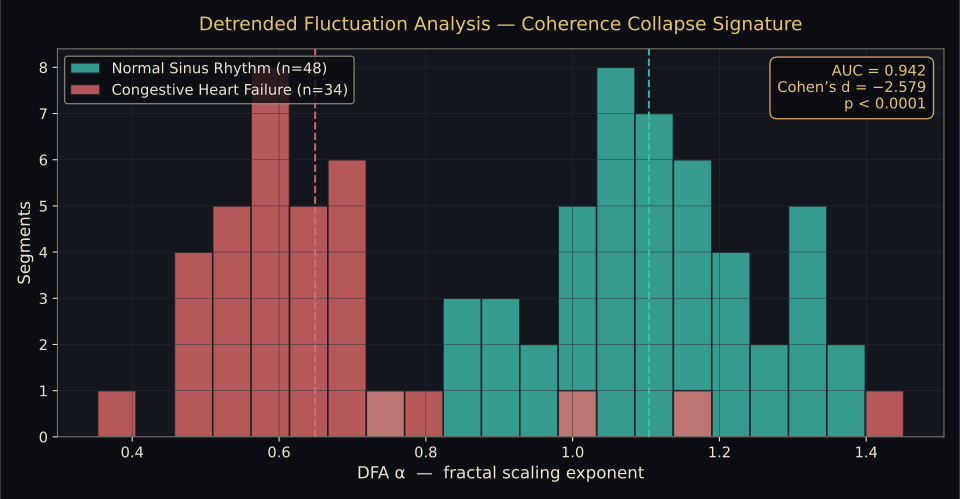
DFA α — the coherence signature.
A healthy heart sits near α ≈ 1.0 — pink noise, long-range correlations, coherent organization across time scales. In severe CHF, α collapses toward 0.65. The distribution separation is what the framework predicts: decoherence is fractal-exponent collapse.
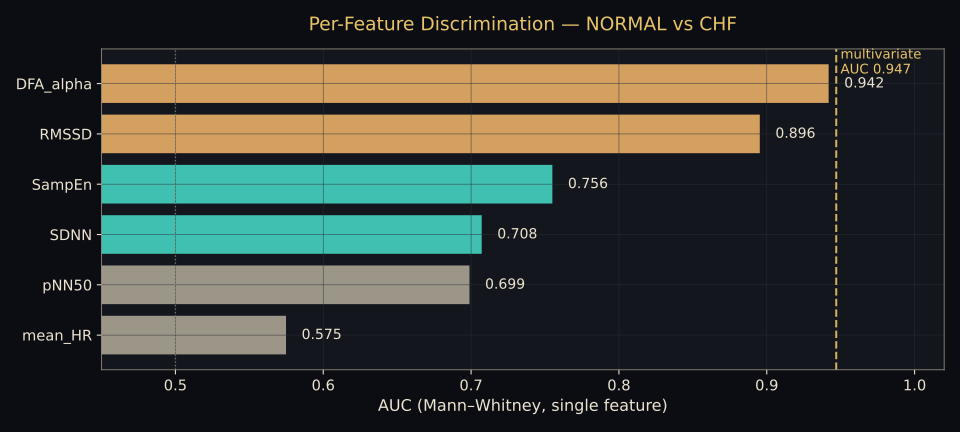
Every feature, one row.
Six HRV features computed per 5-minute segment. Cohen's d measures standardized effect size; AUC is the rank-based probability a CHF segment's value exceeds a normal segment's for that feature.
| Feature | Cohen's d | AUC | p-value | Normal mean | CHF mean |
|---|---|---|---|---|---|
| DFA α | −2.579 | 0.942 | < 0.0001 | 1.104 | 0.649 |
| RMSSD (ms) | +1.525 | 0.896 | < 0.0001 | 34.54 | 191.75 |
| SampEn | −0.980 | 0.756 | 0.0001 | 0.877 | 0.479 |
| SDNN (ms) | +0.930 | 0.708 | 0.0014 | 70.63 | 140.98 |
| pNN50 (%) | +0.796 | 0.699 | 0.0022 | 6.49 | 19.13 |
| mean HR (bpm) | +0.223 | 0.575 | 0.2489 | 88.82 | 92.25 |
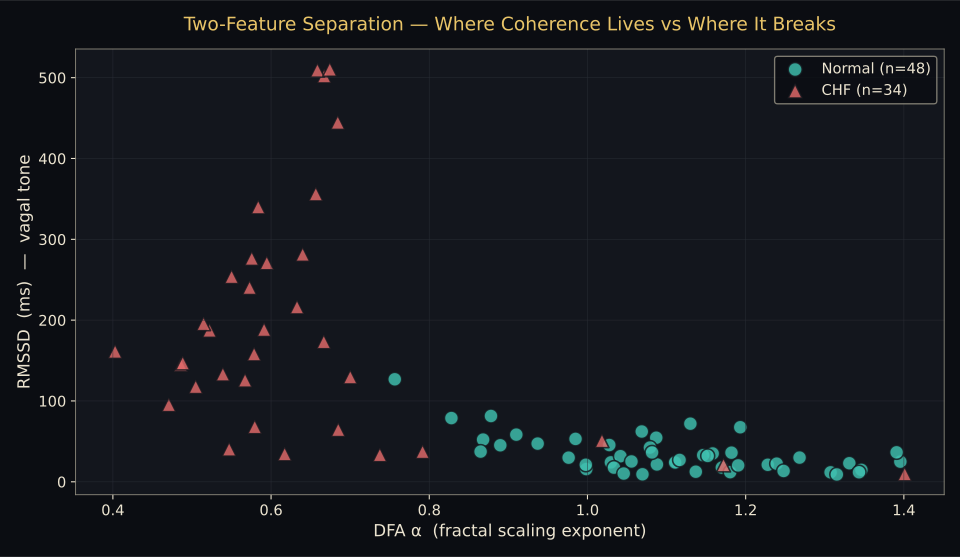
Where coherence lives. Where it breaks.
Plotting DFA α against RMSSD lays the two cohorts on different manifolds. Normal sits in a narrow fractal band with moderate vagal tone. CHF fans out toward both α-collapse and RMSSD inflation — classic autonomic dysregulation on top of fractal failure.
This is what the math said would happen.
As γeff rises toward the critical threshold γc, coherence decays exponentially. The prediction is that decoherence is not just a loss of amplitude — it is a loss of structure across scales. A coherent biological system shows pink-noise (1/f) fluctuations; a decoherent one loses that scaling and drifts toward uncorrelated noise. DFA α measures exactly that fractal exponent.
CHF is a sustained γeff excursion at the cardiac level. The prediction: α should collapse from ~1.0 toward ~0.5–0.7 as the coherent attractor is lost. The data: Normal α mean = 1.104; CHF α mean = 0.649. That's the prediction, measured.
How the numbers were made.
Reproduce it. Dispute it. Extend it.
What we're already building.
Phase 1 answers "does HRV discriminate?" Phase 2 answers the real clinical question: does adding C-reactive protein push the discrimination ceiling above 0.947 in a cancer cohort? That requires paired HRV + inflammation + outcome data, which lives in MIMIC-IV.
If you work on this, reach out.
Cardiologists, oncologists, HRV researchers, MIMIC-IV credentialed PIs, journalists, funders. The raw data is above. The pipeline is one file. The hypothesis is falsifiable. The theory predicted the number before the number existed.
Research and decision-support only · Not medical advice
Does not replace licensed clinical diagnosis or treatment
if you're still here — ask something real.
ask buddy →